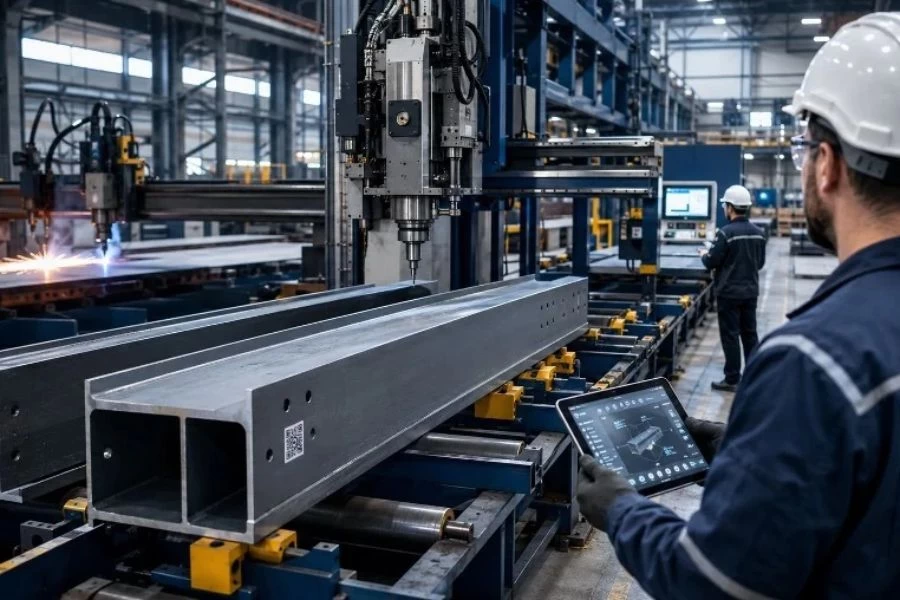
In 2026, structural steel fabrication is moving beyond the question of how fast individual machines can run. More fabricators are focusing on how to reduce manual work, improve member identification, and move engineering data more directly into production.
For most fabrication shops, this does not mean automating the entire facility at once. A more practical approach is to identify the process causing the most labor, delays, errors, or repeated data entry, then improve that bottleneck first.
Labor availability remains part of this challenge. According to the 2025 Workforce Survey from the Associated General Contractors of America (AGC) and NCCER, 92% of contractors that were hiring reported difficulty finding qualified workers, while 45% said labor shortages had contributed to project delays. Although the survey covers the broader construction industry, it reflects the labor pressure affecting the construction and engineering supply chain.
Source: Associated General Contractors of America (AGC) — 2025 Workforce Survey
Trend 1: Automation Is Focusing on Reducing Manual Steps
Structural steel fabrication involves connected processes such as sawing, drilling, marking, assembly, and inspection.
A faster machine does not automatically improve total throughput if operators still need to measure manually, re-enter fabrication data, reposition members, or repeatedly verify part information between processes.
For H-beams, channels, and other structural sections, each member may have different hole locations, dimensions, and cutting requirements. The value of an H-beam drilling machine, steel drilling line, or sawing system therefore depends not only on processing speed, but also on how much manual positioning and repeated data entry it can remove.
For example, Guanda's STD-105 Drilling Center combines three-spindle drilling with automated material handling options to reduce repeated manual operations. The actual benefit depends on the shop's material sizes, drilling requirements, and production layout.
AISC's Modern Steel Construction discussed similar issues in its 2024 feature Automation Authorities, including skilled-labor shortages, automated fabrication equipment, use of existing engineering data, and reduced manual programming. The article also emphasized that the appropriate level of automation depends on the individual fabrication shop.
Source: AISC — Modern Steel Construction, May 2024, "Automation Authorities"
Before comparing machine specifications, fabricators should first ask:
- Which process currently consumes the most labor?
- Where do errors or delays occur most often?
- Can new equipment reduce repeated positioning or data entry?
These questions often provide a better starting point than maximum machine speed alone.
For a closer look at equipment applications across steel fabrication processes, see Key to Improving Steel Structure Processing Efficiency: Guanda International Machinery's Automated Solutions.
Trend 2: Member Identification Is Becoming More Important for Traceability
Structural steel projects can contain large numbers of similar-looking members with different dimensions, hole patterns, fabrication details, or erection locations.
After machining, one of the most basic production questions is still: Which member is this?
Traditional methods such as handwriting, paint marking, or labels can work, but the amount of manual effort increases as project size and member count grow.
Automated marking can add member numbers or other identification information directly during fabrication, reducing the need to reposition, rewrite, or remark members after machining.
For example, the Guanda SLM Steel Laser Marking Machine uses four laser marking units to mark structural steel surfaces. It can apply member identification, processing information, and layout references directly to the workpiece, supporting subsequent fabrication operations.
Member identification and production traceability are not the same thing. A marked beam does not automatically provide complete production tracking. However, consistent identification makes it easier to connect each member with later production, inspection, shipping, or installation information.
For shops that frequently spend time identifying members or repeating marking work, the first step is to review where marking currently occurs and whether that information needs to remain available in later processes.
For more details on marking methods and their applications, read How to Easily Perform Marking on H-Beams?
Trend 3: Tekla Structures Data Is Moving Closer to Fabrication Equipment
Many structural steel projects already use Tekla Structures or other BIM and detailing software.
The key question for fabricators is not simply whether a 3D model exists, but whether the fabrication data already created in that model still has to be entered again at the machine.
According to Trimble's Tekla Structures 2026 documentation, Tekla Structures can create NC files for CNC machine tools. DSTV-format files can include fabrication information such as part length, hole locations, bevels, notches, and cuts.
Source: Trimble — Tekla Structures 2026, Create NC Files in DSTV Format
The goal is to reduce a workflow such as:
Model completed → Drawing interpreted manually → Fabrication data entered again → Machine processing
If operators still need to re-enter hole locations, lengths, or cutting information, fabricators should review whether the limitation comes from the data format, machine compatibility, or the current workflow.
Guanda's GD-SFM Steel Fabrication Management Software supports industry file formats including DSTV, DXF, NC, BOM, and IFC. It allows fabrication data to be prepared, reviewed, and transferred from the office to compatible production equipment.
Using BIM does not automatically make a fabrication shop fully digital. The important point is how much existing engineering data can continue into drilling, cutting, marking, and other production processes without being recreated manually.
Trend 4: Digitalization Is Expanding Beyond Machine Control
Digitalization in structural steel fabrication is increasingly extending into estimating, production planning, data handling, and workflow management.
AISC's Modern Steel Construction discussed examples of steel fabricators using AI and software automation for material takeoff, drawing recognition, and downstream data transfer in its 2024 feature Attesting to AI.
Source: AISC — Modern Steel Construction, October 2024, "Attesting to AI"
For most fabricators, however, the first question should not be whether AI is needed.
A more practical question is:
Which information is still being copied, entered, or checked more than once?
If the same member data is handled repeatedly by engineering, machine operators, and production managers, improving those data handoffs may provide more immediate value than introducing another standalone digital tool.
Production management systems can also extend digital workflows beyond individual CNC machines. For example, Guanda's GD-SFC Steel Fabrication Cloud covers production planning, material management, on-site monitoring, and production data analysis. Such systems help fabricators organize information across multiple stages rather than managing each process separately.
Do Steel Fabricators Need to Automate the Entire Production Line at Once?
No.
Different fabrication shops have different bottlenecks, so a phased approach is often more practical than installing a complete automated line at once.
For example:
- If drilling and positioning require excessive labor, improve the drilling process first.
- If cutting speed or angle accuracy is the main issue, review the sawing process.
- If members are difficult to identify after machining, improve the marking process.
- If machines are already automated but operators still re-enter fabrication data, improve the connection between engineering software and production equipment.
The goal is to solve the current bottleneck while keeping future process integration in mind.
For shops considering a more connected production line, Guanda also offers Smart System Integration (SSI) solutions that combine drilling, sawing, marking, and material handling equipment according to factory layout and workflow requirements.
How Does Guanda Address Different Structural Steel Fabrication Bottlenecks?
Guanda International Machinery provides structural steel fabrication equipment and production management solutions covering drilling, sawing, marking, and production data management.
The starting point depends on the actual production problem.
Drilling
If beam drilling or hole processing is the main bottleneck, an H-beam drilling machine or steel drilling line may help reduce manual positioning and repeated setup.
The STD-105 Drilling Center provides three-spindle drilling, hydraulic clamping, and automated feeding options for structural steel processing.
Sawing
If cutting capacity, cutting accuracy, or material handling is causing delays, the current sawing process should be reviewed first.
Guanda's SBS Double Mitre Bandsaw supports angle cutting for different structural steel sections, with multiple cutting capacities available.
A practical example is Guanda's structural steel fabrication customer case in Taiwan, which describes the integration of an SBS-650 bandsaw and STD-105 drilling machine into an automated production system.
Marking
If member identification still depends heavily on manual marking, the SLM Structural Steel Laser Marking Machine can integrate marking into the fabrication process and reduce repeated positioning and manual marking work.
Production Data Management
If the problem extends beyond machine processing into engineering data and production planning, GD-SFM Steel Fabrication Management Software can support fabrication-data organization and production preparation using industry-standard file formats.
Before recommending equipment, Guanda first reviews:
- which process consumes the most labor
- which errors occur most often
- whether existing engineering data can be used directly in the next production step
This helps determine whether drilling, sawing, marking, or production-data integration should be addressed first.
What Information Should You Prepare Before Selecting Structural Steel Fabrication Equipment?
Providing actual production information makes equipment evaluation more useful than starting with general machine specifications.
Prepare the following:
- Material and section types: H-beams, channels, or other structural sections.
- Actual size and length ranges: the dimensions processed regularly.
- Required processes: drilling, sawing, marking, or multiple operations.
- Hole, cutting, and marking requirements: key fabrication conditions that affect machine selection.
- Production volume: typical daily or monthly throughput.
- Current data sources: Tekla Structures, Excel, or other detailing and production data.
- Current bottlenecks and material flow: where waiting time, errors, repeated handling, or manual work currently occur.
These details help determine whether the main issue is machine capacity, manual handling, member identification, or production-data transfer.
FAQ
Q1. Can new structural steel fabrication equipment be integrated into an existing production line?
Yes, new equipment can often be introduced without replacing the entire production line. However, integration depends on the existing material handling system, equipment layout, and production workflow.
Fabricators should evaluate how materials will enter and leave the new machine, whether additional handling equipment is required, and how the new process will connect with upstream and downstream operations.
For shops planning gradual upgrades, these factors should be reviewed before finalizing equipment specifications.
Q2. Can different brands of steel fabrication machines share production data?
Data sharing may be possible, but compatibility depends on the file formats, communication interfaces, and software capabilities supported by each machine.
Even when two machines support the same file format, they may interpret or use fabrication data differently.
Before purchasing new equipment or production management software, fabricators should confirm which data can be imported, exported, or transferred between their existing systems and the proposed solution.
Q3. What information can be included in automated steel member marking?
Depending on the marking equipment and software configuration, automated marking may support member numbers, identification codes, assembly references, or other project-specific information.
Buyers should confirm the supported marking content, character sizes, marking positions, and compatibility with their steel section types.
It is also worth checking whether the markings will remain readable after subsequent processes such as surface treatment or painting.
Q4. What should overseas buyers confirm before installing structural steel fabrication equipment?
In addition to machine specifications, overseas buyers should clarify installation requirements and the support available after delivery.
Important considerations include electrical requirements, available floor space, material loading and unloading arrangements, software setup, operator training, spare parts availability, and technical support.
Installation responsibilities, commissioning arrangements, and after-sales service should be confirmed with the equipment supplier before placing an order.
If you are planning the next stage of structural steel fabrication automation, prepare your section types and sizes, required processes, production volume, current marking method, engineering-data sources, and current bottlenecks.
With this information, Guanda International Machinery can help evaluate whether drilling, sawing, marking, or production data management should be addressed first.